
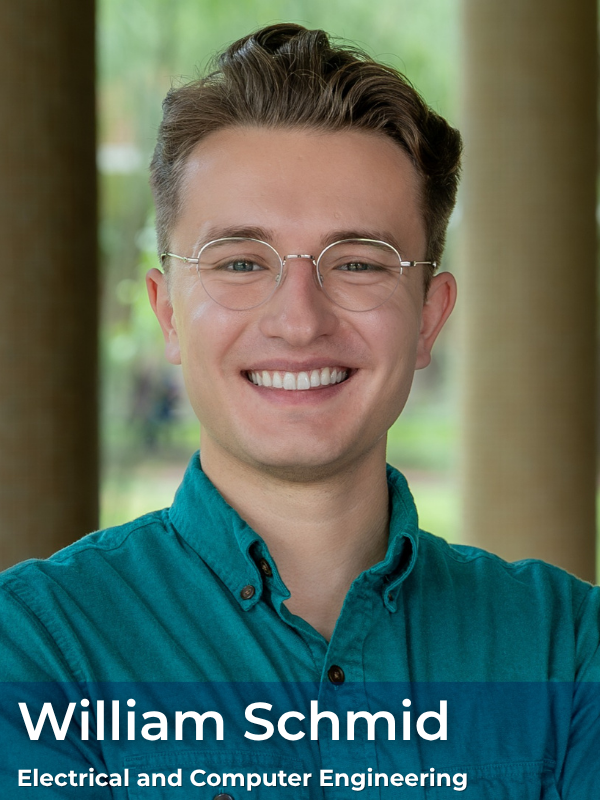
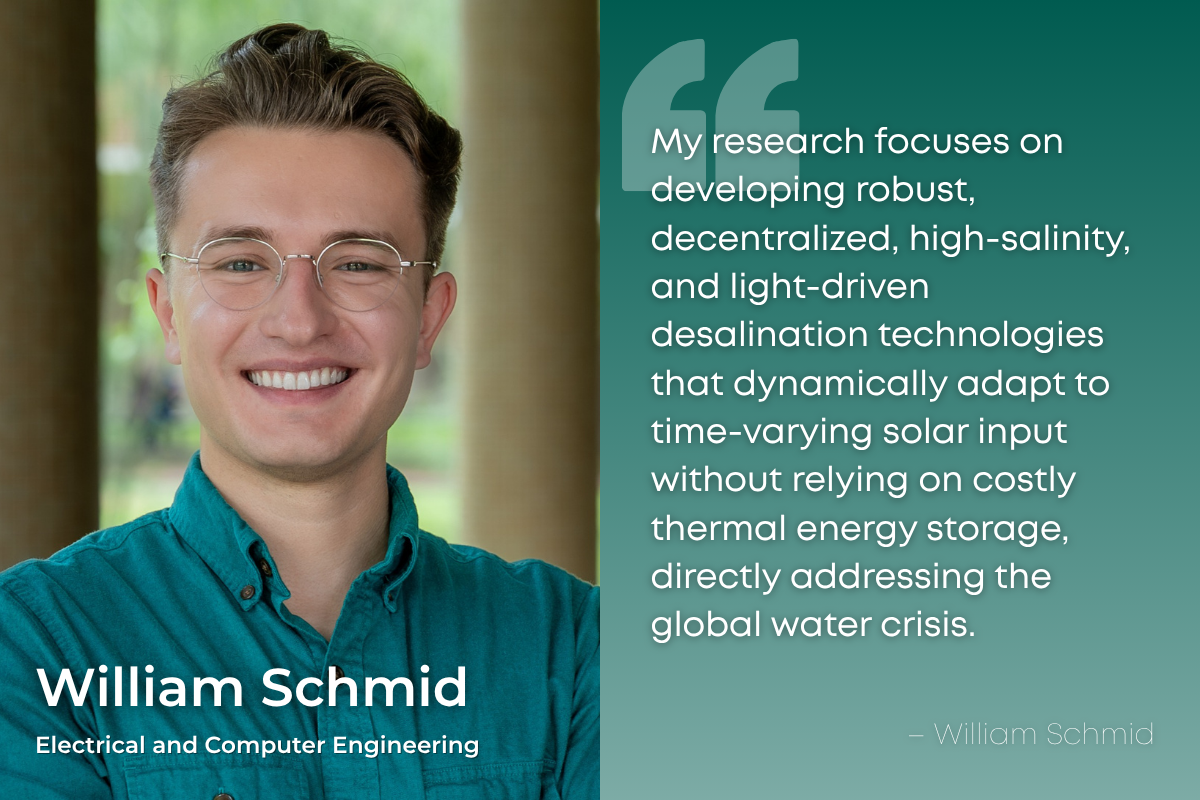
Meet William Schmid
Department: Electrical and Computer Engineering
Expected Graduation Date and Degree: 2025, Ph.D.
Hometown: Minneapolis, Minnesota
LinkedIn: William Schmid
Google Scholar: William Schmid
Q: What broad problem does your thesis aim to address?
A: Desalination systems will become increasingly important in the coming decades as climate change and population growth strain limited freshwater resources. Current, widely-utilized seawater desalination technologies, such as reverse osmosis (RO), can achieve high energy-to-water efficiency but face challenges related to high-salinity/highly-contaminated feed sources, as well as waste brine disposal. Moreover, much of the world’s water scarcity occurs in off-grid and low-resource areas, precluding the use of RO and other heavy-infrastructure practices requiring centralized infrastructure. Solar/renewables-driven thermal desalination shows potential for decentralization; however, many proposed systems rely on hydrophobic membranes for salt separation, which are highly prone to scaling, fouling, and structural failure. Similar to RO, these membranes limit desalination performance with high-salinity feeds.
Moreover, renewables-driven technologies suffer from inherent power intermittency. External thermal energy storage (TES) technologies have been proposed to mitigate the inconsistent production that comes with time fluctuations in power, but these technologies are often large-scale and add to the overall maintenance burden and costs of a system. Established thermal solutions such as multistage flash desalination (MSF) and multiple effect desalination (MED) can achieve high water capacity and the lowest energy consumption of all thermal processes, but take the form of large, centralized plants relying on large, centralized heat sources, scale poorly to smaller footprints, and have high initial costs. There is a need for lean, low-maintenance, and decentralized, renewables-driven desalination technologies to extract valuable freshwater from high salinity sources and reject brines and relieve water scarcity in off-grid communities.
Q: Can you provide more scholarly depth to your research?
A: We aim to further investigate and eventually commercialize a novel, fully-decentralized solar thermal desalination technology, dubbed Solar Thermal Resonance Energy Exchange Desalination (STREED). STREED sets several benchmarks within the desalination sphere related to 1) decentralizability and off-grid operation, 2) modularity and scalability, 3) system robustness and maintenance, and 4) high salinity water treatment. STREED is a membrane-free system built from accessible materials capable of evaporating and condensing water using a self-contained, dynamic energy recovery scheme dubbed resonant energy transfer (RET). RET, which frames multi-flow energy transfer in the physics language of oscillating systems, was previously verified to increase desalination efficiency in light-driven membrane systems and has been extended to membrane-less humidification-dehumidification systems for STREED (see Schmid et al., Nature Water 3, 605–616, 2025). Countercurrent heated fluid and vapor flow rates are manipulated according to RET in response to time-varying solar power, enabling efficient desalination at all times of day and positive nocturnal production rates without external TES.
Models of our novel STREED system predict water production of 3–5 L/kWh with up to 24 hours of continuous operation under intermittent solar intensity. Based on humidification-dehumidification desalination principles, STREED is well-equipped to purify highly saline and contaminated water sources, and it also shows potential as a zero liquid discharge (ZLD) technology, a system that produces no brine, only freshwater and solid minerals. Coupled with reverse osmosis technologies, STREED shows potential as an energy-efficient and cost-effective method for managing waste brine. Though we will target the management of RO reject as our primary application and market on our path to commercialization, STREED serves humanitarian goals as well as an electricity-free, readily scalable technology. STREED can meet the water demands of variably sized, infrastructure-poor communities.
Q: Are there any products from your work so far that you'd like to highlight?
A: Papers: 1. W. Schmid et al. Decentralized solar-driven photothermal desalination: an interdisciplinary challenge to transition lab-scale research to off-grid applications. ACS Photonics 9 (12), 3764-3776 (2022) DOI: 10.1021/acsphotonics.2c01251
2. Schmid, W., Machorro-Ortiz, A. et al. Resonant energy transfer for membrane-free, off-grid solar thermal humidification–dehumidification desalination. Nature Water 3, 605–616 (2025).DOI: 10.1038/s44221-025-00438-3
3. Schmid, W. et al. Fully decentralized solar thermal Desalination: challenges and pathways revealed by generalized positive feedback model. Preparing Submission (2025)
Additional outputs: 1. 2nd Place Winner for the 2025 RELX Environmental Challenge, presented STREED desalination technology at the 2025 Pollutec environmental technology exhibition in Lyon, France as part of award 2. Multiple oral and poster presentations at Smalley-Curl Summer Research Colloquiums (2025 Platinum Award/First Place oral presentation winner) and conferences including SPP and CLEO 3. Masters thesis (2023) and doctoral thesis (in preparation, 2025)
Q: In your view, what is the most pressing sustainability challenge today?
A: It is difficult to select "the most" pressing sustainability challenge as all pressing challenges related to climate change mitigation have complex interactions and must be addressed in concert. Nevertheless, water scarcity, especially off-grid and remote-area water scarcity, are severely under-addressed problems. Per the 2024 United Nations World Water Development Report, 2.2 billion people have no access to clean drinking water, and water resources are likely to be further strained in the near future due to several environmental and social factors. The UN report argues for the critical role of desalination in mitigating increasing water challenges, yet makes clear that the energy intensity of desalination technologies, currently a quarter of the energy used by the entire water sector, presents issues in expanding water access sustainably. The report presents a world map of drought vulnerability, with much of the highest vulnerability occurring in regions with limited centralized power infrastructure (e.g., parts of Sub-Saharan Africa, Central America, Northern South America, and Northeastern and Central Asia). There is an increasingly pressing need for advanced yet low-cost desalination technologies that can be decoupled from fossil fuel-driven energy infrastructure and can access all possible sources of freshwater, regardless of salt, contaminant concentration.
In the United States and in other wealthy nations already relying on centralized desalination to meet water demand, there is a pressing need for effective waste brine management solutions due to the present difficulty of environmentally safe and cost-effective brine transport and disposal. Waste brine, as well as fossil-fuel industry waste water and brackish groundwater, are also untapped sources of freshwater that could be extracted with sustainable, high-salinity technologies.
Q: How do you see your research contributing to solutions for sustainability challenges?
A: STREED (Solar Thermal Resonant Energy Exchange Desalination) is designed to fill this gap. It is a robust, membrane-free solar thermal desalination system that combines humidification-dehumidification with dynamic resonant energy transfer (RET), enabling self contained energy recovery and 24-hour freshwater production without external thermal storage. This makes STREED uniquely capable of (i) producing clean water from highly saline or contaminated sources, (ii) operating off-grid in low-resource environments, and (iii) serving as a zero-liquid-discharge solution for brine management in industrial settings. Its practical applicability lies in its scalability, low-maintenance design, and compatibility with readily available materials, making it deployable in both humanitarian and industrial contexts. Field-relevant modeling predicts production rates of 3–5 L/kWh with continuous operation under variable solar input, meeting daily drinking water needs for small communities with a minimal footprint. Moreover, its modular architecture allows capacity to grow with demand, while its membrane-free construction reduces failure risks and maintenance burdens. Overall, STREED translates nearly a decade of Rice University research, including five years of my own, into a practical, field-ready desalination solution aimed at closing critical water access and brine management gaps worldwide.
Q: What are your career aspirations after graduation?
A: I intend to stay at Rice and work to commercialize our novel STREED system by spinning out a Rice-based company. The initial development of STREED has been driven by humanitarian aims: expanding access to water for vulnerable, off-grid communities. However, the versatility of STREED as a fully-decentralized, low-maintenance, and high-salinity water purifier makes it an attractive deep tech investment for a range of stakeholders in the short term. Reverse osmosis reject management is an untapped market; the large-scale desalination industry supporting wealthy arid countries is sorely missing a cost-effective, low impact solution to process environmentally damaging and costly waste brine.
Q: Would you like to acknowledge any funding sources or advisors who have been especially supportive of your research journey?
A: I am grateful to the NSF for my National Science Foundation Graduate Research Fellowship (NSF-GRFP, 2022). Additional funding support has come from the U.S. Department of Energy through the American-Made Challenge: Solar Desalination Prize program. I am especially grateful to my advisor, Professor Alessandro Alabastri, for his detailed and frequent, yet always kind and encouraging feedback on my work. I am also thankful for my thesis committee members Professors Naomi J. Halas and Geoff Wehmeyer.