
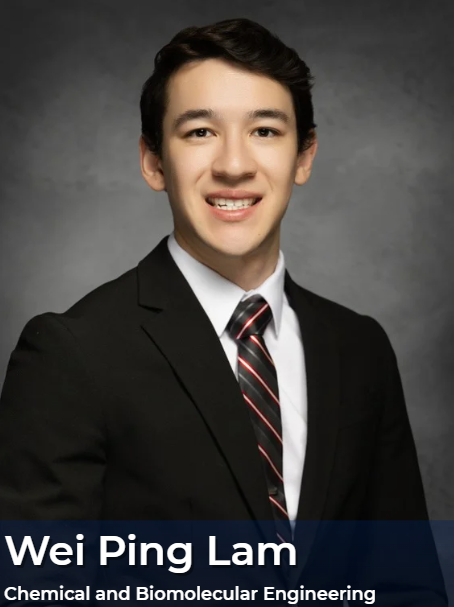
Meet Wei Ping Lam
Department: Chemical and Biomolecular Engineering
Expected Graduation Date and Degree: 2027, Ph.D.
Hometown: Chicago, Illinois
LinkedIn: Wei Ping Lam
Q: What broad problem does your thesis aim to address?
A: Naturally, CO2 cycles throughout the ecosystem, but the excessive burning of fossil fuels and their emission of CO2 into the atmosphere dramatically offsets this cycle. While many look at efficiently capturing CO2, my research focuses on converting it into valuable fuels and chemicals through electrochemical pathways. Integration with renewable electricity provides a sustainable approach and an effective means of closing the carbon cycle.
Q: Can you provide more scholarly depth to your research?
A: My research specifically focuses on the electrochemical CO2 reduction reaction (CO2RR) for the production of formic acid. One obstacle in CO2RR is the difficulty of converting dilute CO2 sources. At low concentrations, the CO2RR becomes diffusion limited and the competing hydrogen evolution reaction (HER) takes over. My approach harnesses high pressures (>10 bar) to enhance CO2 activity at the reaction interface. As a result, we observe significantly improved reaction rates and product selectivity. Beyond improving activity, high-pressure operations may also fundamentally alter the microenvironment at the catalyst interface, as CO2 is an acidic gas, thereby enabling improved stability for these systems.
Q: Are there any products from your work so far that you'd like to highlight?
A: Lam, W. P., Wi, T., Elgazzar, A., Haoe, S., Paulino, M., Okatenko, V., Sellers, C., Zhang, J., & Wang, H. (2025) High-Pressure Electrochemical CO2 Capture and Reduction to Formic Acid. ACS Energy Letters, 10(11), 5466-5473
Q: In your view, what is the most pressing sustainability challenge today?
A: I believe that creating sustainable solutions, but in an affordable way, is a major challenge. For example, it is tempting for people to choose the cheapest electricity provider rather than opting for green energy from renewable sources. Making sustainable technologies affordable would have a transformative impact.
Q: How do you see your research contributing to solutions for sustainability challenges?
A:My research advances sustainability by converting waste CO2 from industrial processes (like steam methane reforming tail gas) directly into valuable fuels like formic acid using renewable electricity. Integrating CO2 capture and conversion in a stable, high-pressure electrochemical system enables efficient carbon recycling.
Q: What are your career aspirations after graduation?
A: After graduation, I plan to transition over to industry. I aim to contribute to tangible research and develop affordable, scalable solutions, whether at the start-up scale or within a large company. I find myself digging deep into technical engineering work that relates to the energy transition.
Q: Would you like to acknowledge any funding sources or advisors who have been especially supportive of your research journey?
A: I would like to extend my gratitude to Dr. Haotian Wang for his invaluable advice and for keeping me motivated throughout my studies. I would also like to thank my mentor, Dr. Tae-Ung Wi, for guiding me through research and teaching me experimental techniques.