

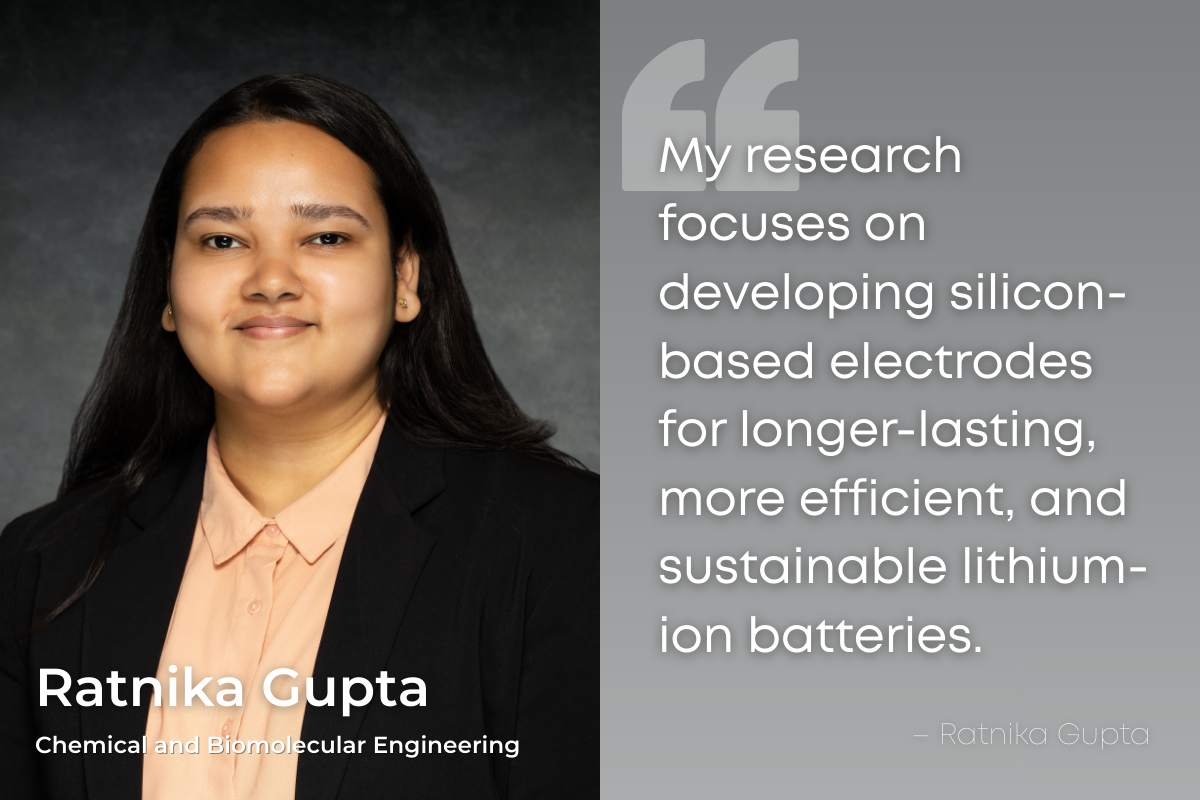
Meet Ratnika Gupta
Department: Chemical and Biomolecular Engineering
Expected Graduation Date and Degree: 2027, Ph.D.
Hometown: Ghaziabad, India
LinkedIn: Ratnika Gupta
Google Scholar: Ratnika Gupta
Q: What broad problem does your thesis aim to address?
A: My research focuses on developing silicon-based electrodes to make lithium-ion batteries lighter, longer-lasting, and more sustainable. Current batteries rely on low-capacity materials and heavy metals that limit their performance in large-scale applications, such as transportation and grid storage. By developing new silicon-based composites that store more energy and use sustainable materials, I aim to enhance the performance and efficiency of lithium-ion batteries to support the clean energy transition.
Q: Can you provide more scholarly depth to your research?
A: My research involves designing silicon-based composites to replace conventional graphite electrodes used in lithium-ion batteries. Silicon offers much higher theoretical capacity but suffers large volume expansion and instability during cycling. To overcome these challenges, I am designing silicon composites by integrating carbon nanotubes and conductive polymers that maintain structural stability and improve electrochemical performance. Additionally, the heavier copper is replaced with a lightweight carbon nanotube-based current collector to reduce the inactive mass, resulting in more sustainable batteries with enhanced energy density. Together, these efforts aim to develop scalable, high-performance electrodes for advanced batteries that can power electric vehicles and stationary storage systems more efficiently.
Q: In your view, what is the most pressing sustainability challenge today?
A: The most pressing sustainability challenge today is the transition from fossil fuels to renewable energy sources. While fossil fuels generate high-carbon emissions, renewable sources are intermittent and require reliable energy storage to be viable on scale. Advancing high-performance, efficient, and sustainable energy storage technologies is essential to enable a truly clean and reliant energy transition.
Q: How do you see your research contributing to solutions for sustainability challenges?
A: The most pressing sustainability challenge today is the transition from fossil fuels to renewable energy sources. While fossil fuels generate high carbon emissions, renewable sources are intermittent and require reliable energy storage to be viable on scale. Advancing high-performance, efficient, and sustainable energy storage technologies is essential to enable a truly sustainable energy transition.
Q: What are your career aspirations after graduation?
A: After graduation, I hope to keep advancing energy storage systems through an R&D role focused on developing practical solutions for sustainable energy.
Q: Would you like to acknowledge any funding sources or advisors who have been especially supportive of your research journey?
A: I would like to acknowledge the support from the Carbon Hub.