
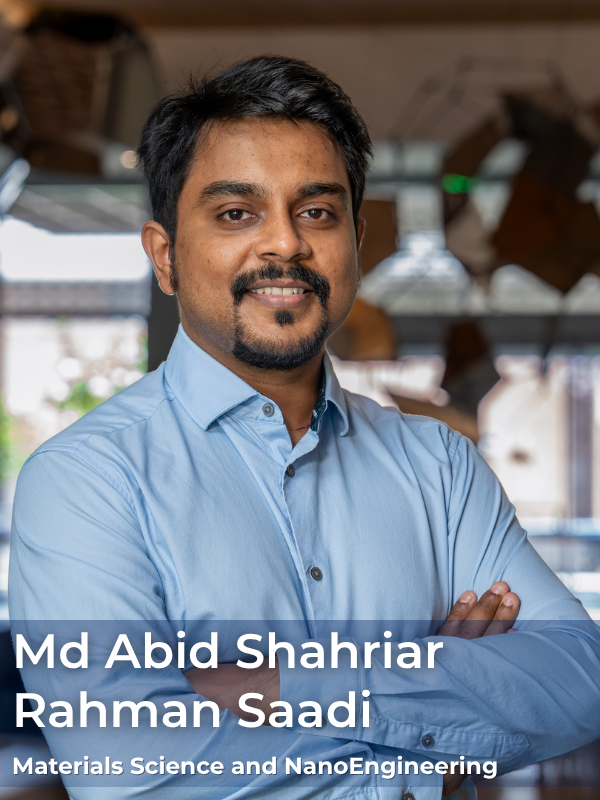
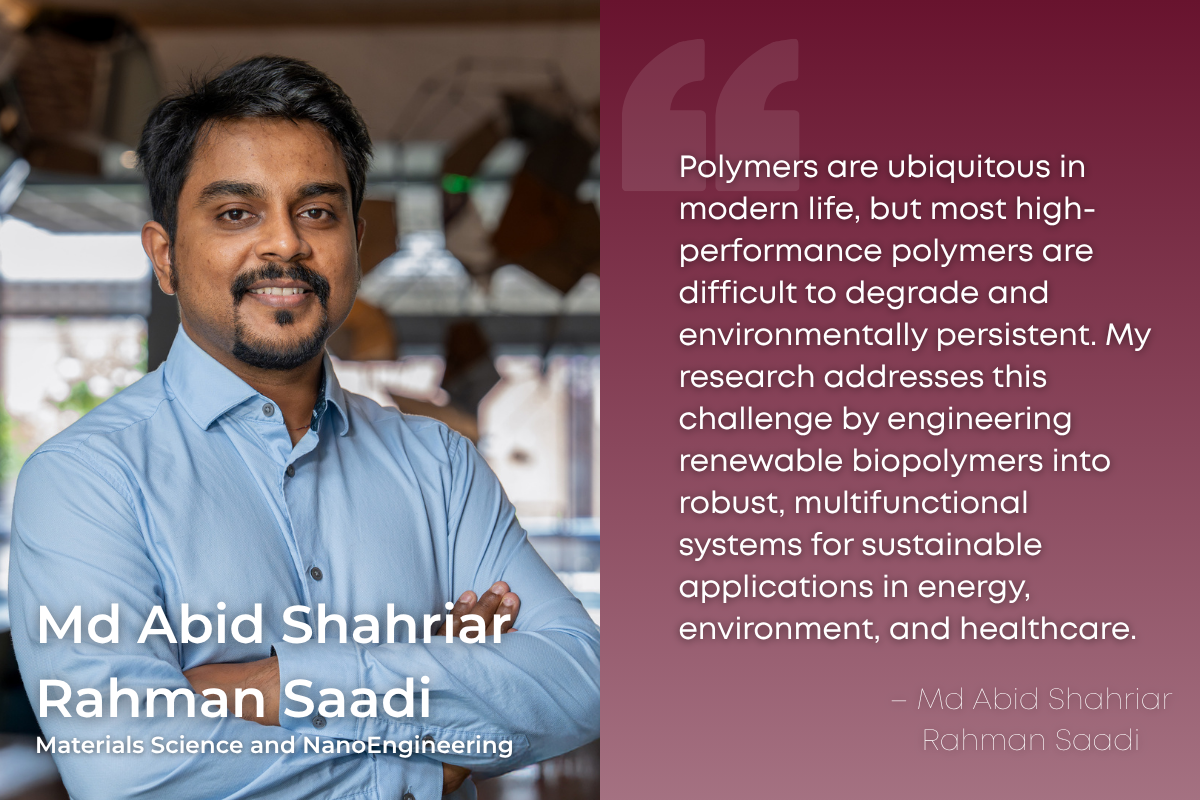
Meet Md Abid Shahriar Rahman Saadi
Department: Materials Science and NanoEngineering
Expected Graduation Date and Degree: 2026, Ph.D.
Hometown: Natore, Bangladesh
LinkedIn: Md Abid Shahriar Rahman Saadi
Google Scholar: Md Abid Shahriar Rahman Saadi
Q: What broad problem does your thesis aim to address?
A: Polymers are ubiquitous in modern life with applications in structural, packaging, food, textiles, electronics, cosmetics, biomedical and energy technologies. Yet a critical paradox remains: robust, multifunctional polymers are typically non-degradable and environmentally harmful, while degradable polymers rarely offer the synergistic mechanical and functional performance of their synthetic counterparts. In other words, functionality and degradability have remained mutually exclusive. My research addresses this exclusiveness by engineering multifunctionality into degradable polymers.
Q: Can you provide more scholarly depth to your research?
A: My research is focused on engineering renewable, natural, and biodegradable polymers into robust, multifunctional systems. By combining (1) hierarchical structural tuning, (2) bioinspired and biomimetic design strategies, and (3) advanced processing and manufacturing, I aim to create complex materials with tailored morphologies, superior mechanical performance, and novel functionalities. Beyond fundamental science, my research directly contributes to the development of carbon-neutral technologies that benefit the environment, economy, and society.
During my PhD, I have pioneered methods for rotational culture of bacterial cellulose, waste algae-derived nanocomposites, 3D printed wood, antifreeze biogel electrolyte for batteries, and sustainable coatings for food preservation. In the future, I plan to expand this approach to living and adaptive biopolymer systems, 3D-printed regenerated wood structures that integrate sustainability with functionality, and biohybrid materials capable of addressing urgent needs in food safety, energy storage, and environmental remediation.
Q: Are there any products from your work so far that you'd like to highlight?
A: Flow-induced 2D nanomaterials intercalated aligned bacterial cellulose; Algae-Derived Nacre-like Dielectric Bionanocomposite with High Loading Hexagonal Boron Nitride for Green Electronics; Three-dimensional printing of wood; Sustainable valorization of asphaltenes via flash joule heating
Q: In your view, what is the most pressing sustainability challenge today?
A: I believe the most pressing sustainability challenge today is developing materials and technologies that balance human progress with environmental responsibility. We’ve built our modern world on materials that are durable, scalable, and high-performing — but not degradable or renewable. This “functionality versus sustainability” trade-off has led to massive plastic pollution, resource depletion, and greenhouse gas emissions. The real challenge now is to design next-generation materials that maintain performance while being recyclable, biodegradable, and carbon-neutral across their entire life cycle.
Q: How do you see your research contributing to solutions for sustainability challenges?
A: My research aims to bridge the gap between performance and sustainability in materials. Today’s high-performance polymers are mostly synthetic and non-degradable, while natural ones are often weak or unstable. I focus on engineering renewable biopolymers — like bacterial cellulose, alginate, and proteins — into robust, multifunctional systems that can replace synthetic plastics in packaging, energy, and structural applications. For example, I recently developed an anti-freezing, anti-drying biogel electrolyte that works at –30°C and a nanocellulose-based coating that extends fruit shelf life sustainably. Broadly, I want to design materials that are not just environmentally benign, but actively enable a circular, carbon-neutral future.
Q: What are your career aspirations after graduation?
A: My vision is to become a faculty member at a leading research institution, where I will advance functional biopolymers and biological materials while mentoring the next generation of scientists and engineers.
Q: Would you like to acknowledge any funding sources or advisors who have been especially supportive of your research journey?
A: I am incredibly grateful to my advisors Professor Maksud Rahman and Professor Pulickel Ajayan. I am also thankful to United States Department of Agriculture (USDA) for providing me funding during my PhD.