
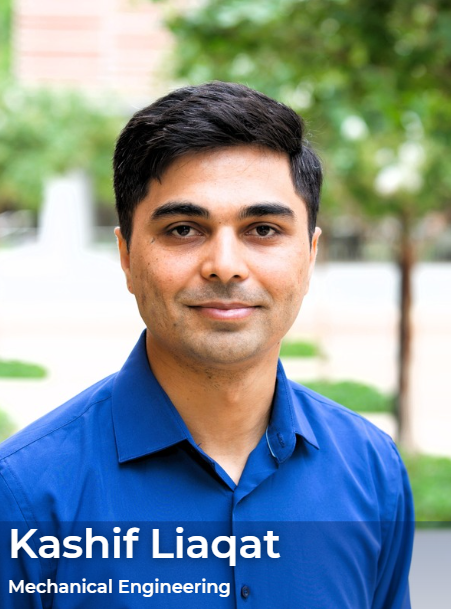
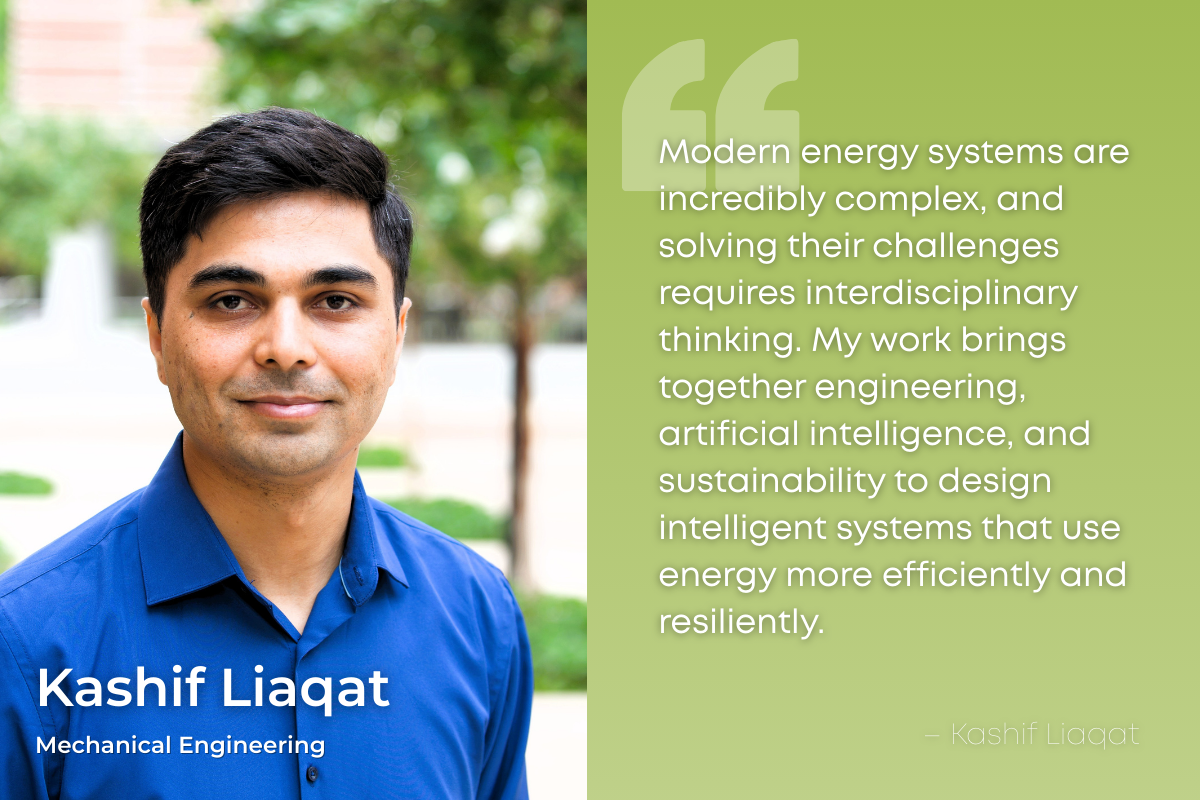
Meet Kashif Liaqat
Department: Mechanical Engineering
Expected Graduation Date and Degree: 2026, Ph.D.
Hometown: Quetta, Pakistan
Website: Kashif Liaqat
LinkedIn: Kashif Liaqat
Google Scholar: Kashif Liaqat
Q: What broad problem does your thesis aim to address?
A: The broad problem my thesis addresses is how to improve the reliability, efficiency, and sustainability of modern energy systems by integrating renewable energy, waste heat recovery, and artificial intelligence within existing and emerging infrastructures. Despite progress in renewable deployment, global energy systems still rely heavily on fossil fuels and suffer from inefficiencies, resource variability, and underutilized waste heat. These challenges affect both legacy industrial infrastructure — such as power plants and manufacturing facilities — and modern digital systems, including data centers with rapidly growing energy and cooling demands. My research develops hybrid and intelligent energy frameworks that enhance system performance across scales, from industrial process heat to digital infrastructure. By combining conventional plants, renewables, hybrid waste heat recovery, and AI-driven optimization, my work seeks to create integrated solutions that improve operational reliability, maximize energy utilization, and reduce costs, all contributing to a more resilient and efficient low-carbon energy future.
Q: Can you provide more scholarly depth to your research?
A: My research focuses on improving the reliability, efficiency, and sustainability of modern energy systems by integrating renewable energy, waste heat recovery, and artificial intelligence. I develop hybrid and intelligent energy solutions that enhance how energy is generated, recovered, and managed across both legacy industrial infrastructure and emerging digital systems such as data centers. In the renewable domain, my work advances concentrated solar power (CSP) technologies through novel configurations and hybridization strategies that make solar energy more flexible and cost-effective. I also design hybrid waste heat recovery systems that capture and reuse thermal energy from industrial processes, gas turbines, and data centers — turning what is typically wasted heat into a valuable resource for power or heating.
Complementing these technologies, I apply artificial intelligence to improve the predictability and operational reliability of energy systems. My deep learning models enhance solar resource forecasting and enable more accurate modeling of carbon capture and storage processes, supporting safer and more efficient CO₂ sequestration. Together, these efforts form an integrated framework that connects renewable generation, heat recovery, and data-driven intelligence. My goal is to create energy systems that are not only low-carbon but also more resilient, adaptive, and efficient — bridging the gap between existing infrastructure and the sustainable technologies of the future.
Q: What scholarly products have resulted from your work so far?
A: My Ph.D. research has resulted in 15 peer-reviewed publications, 2 Department of Energy research grants, more than 10 conference presentations, and a patent currently in the pipeline.
Q: In your view, what is the most pressing sustainability challenge today?
A: In my view, the most pressing sustainability challenge today is not simply producing clean energy, but ensuring that our entire energy system operates reliably, efficiently, and equitably at scale. Modern energy systems are becoming increasingly complex and interdisciplinary — where renewable variability, climate-driven grid disruptions, and emerging digital loads like data centers interact in unpredictable ways. Achieving sustainability now requires not only cleaner technologies, but also smarter integration, adaptive infrastructure, and cross-sector collaboration that link energy, data, and the environment into a cohesive system.
Q: How do you see your research contributing to solutions for sustainability challenges?
A: My work contributes to sustainability by developing interdisciplinary solutions for the complex dynamics of modern energy systems. As renewable generation grows and new digital loads like data centers expand, our energy networks have become deeply interconnected and increasingly difficult to manage. I address this complexity by integrating renewable energy, waste heat recovery, and artificial intelligence into hybrid frameworks that improve efficiency, reliability, and adaptability. By bridging engineering, data science, and systems thinking, my research helps existing and emerging infrastructures — from industrial plants to digital campuses — operate more intelligently and sustainably. The goal is to enable energy systems that not only emit less carbon, but also make smarter use of every resource, adapting dynamically to changing environmental and operational conditions.
Q: What are your career aspirations after graduation?
A: After graduation, I aim to build a career in research and development focused on addressing the complex challenges of modern energy systems. I want to continue advancing solutions that improve the reliability, efficiency, and intelligence of energy infrastructure through AI-driven optimization and forecasting. This path will allow me to stay at the intersection of engineering, data science, and sustainability — continuously learning, adapting, and developing technologies that make real-time, data-informed energy management possible. Ultimately, I hope to contribute to creating smarter, more resilient, and low-carbon energy systems that can adapt to the evolving demands of our world.
Q: Would you like to acknowledge any funding sources or advisors who have been especially supportive of your research journey?
A: I am deeply grateful to my Ph.D. advisor, Dr. Laura Schaefer, for her mentorship, guidance, and constant encouragement throughout my research journey. I have also been fortunate to collaborate with Dr. Alexander J. Zolan at the National Renewable Energy Laboratory (NREL), Wes Stein at the Commonwealth Scientific and Industrial Research Organisation (CSIRO), and Dr. Daniel J. Preston at Rice University, whose insights and collaboration greatly enriched my work. My research has been supported by Flowserve Corporation, the U.S. Department of Energy (DOE), the National Renewable Energy Laboratory (NREL), and the National Science Foundation (NSF).