

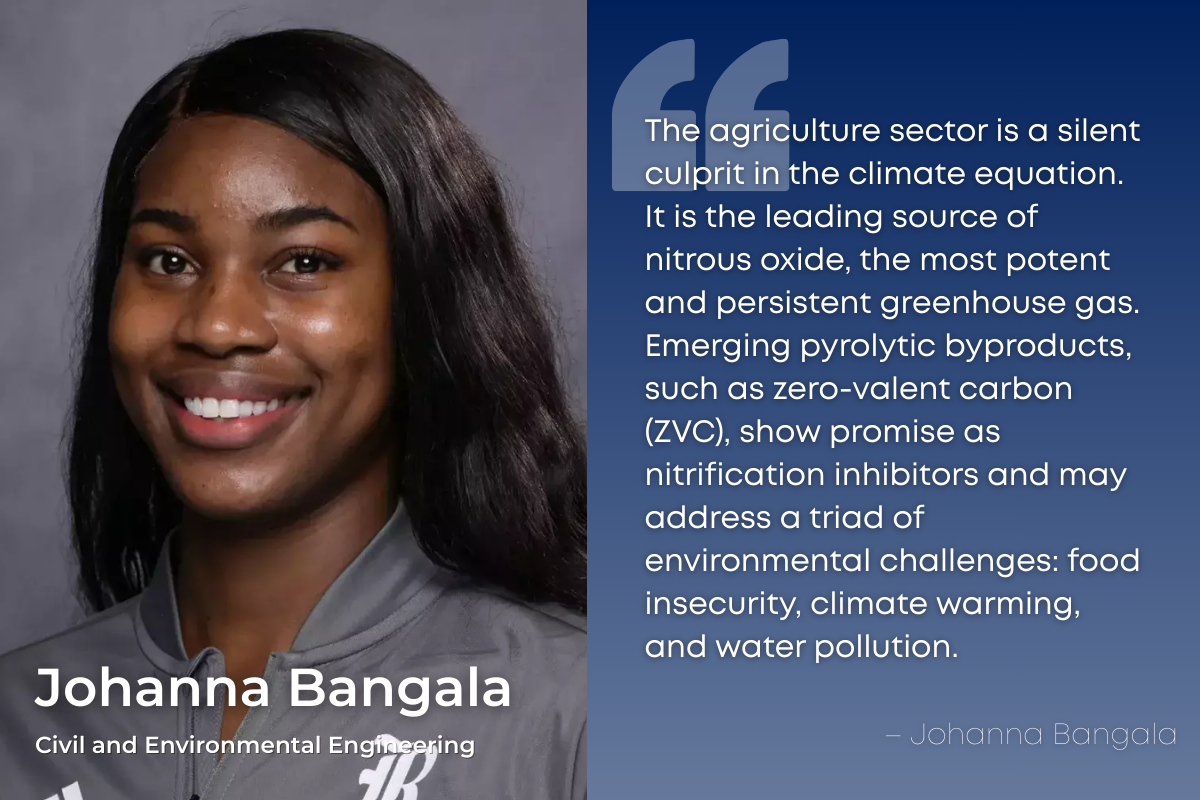
Meet Johanna Bangala
Department: Civil and Environmental Engineering
Expected Graduation Date and Degree: 2028, Ph.D.
Hometown: Mkushi, Zambia
LinkedIn: Johanna Bangala
Q: What broad problem does your thesis aim to address?
A: Agricultural nitrogen pollution impacts on climate stability, water quality, and food security.
Q: Can you provide more scholarly depth to your research?
A: The Nitrogen cycle may have multifaceted impacts on environmental stability, particularly in agricultural systems. In these contexts, nitrifying microorganisms convert ammonium from fertilizer into mobile nitrate, which constitutes the largest source of nitrous oxide (N₂O) emissions both nationally and globally. This process generates 75% of the US N₂O emissions - an exceptionally potent greenhouse gas with global warming potential nearly 300 times that of CO₂ — while simultaneously reducing nitrogen use efficiency (NUE) through nitrate leaching. With a global NUE of only 40%, significant nitrogen losses from fertilizer inputs threaten food security, particularly in developing regions. Furthermore, leached nitrates drive eutrophication and downstream water quality degradation.
In water scarce regions, pyrolytic green hydrogen production from hydrocarbons such as methane is being explored as part of the energy transition. This process yields a solid carbon byproduct— zero-valent carbon (ZVC) — which we hypothesize inhibits nitrification, creating a beneficial bottleneck in the N cycle. Nitrifying microorganisms are autotrophic, slow-growing, and highly sensitive to xenobiotics. In preliminary pure culture experiments using model bacteria for each major Nitrogen transformation — Azotobacter vinelandii (N-fixation), Nitrosomonas europaea (nitrification) and Pseudomonas stutzeri (denitrification) — ZVC selectively inhibited nitrification. Suppressed ammonium consumption, reduced nitrite production, and downregulation of all key nitrification genes corroborated to confirm effective inhibition. We further evaluated the duration of ZVC's inhibitory effect on N. europaea, benchmarking against a known nitrification inhibitor (NI), dicyandiamide (DCD). ZVC maintained effective nitrification inhibition for up to three weeks, with comparable results to DCD.
The next phase involves testing ZVC under more complex soil conditions, focusing on de-risking the material by assessing its effects on non-target soil microbial communities and its performance across different soil types. Preliminary soil microcosm studies show statistically significant reductions in cumulative N₂O and CO₂ fluxes in both sand and clay soils, suggesting ZVC does introduce unintended climate risks. Ongoing analyses aim to further assess reductions in nitrate production as proxy for potential improvements in NUE and mitigation of eutrophication-driven water pollution.
Q: In your view, what is the most pressing sustainability challenge today?
A: Mitigating climate change within the broader context of the energy transition, while simultaneously meeting growing energy demands, ensuring food security, and protecting water quality requires an integrated and systemic approach. The energy transition is inherently gradual, involving both direct and indirect strategies. Direct efforts include the diversification of renewable energy sources such as solar, wind, geothermal, green hydrogen. Indirect mechanisms such as carbon credits and waste monetization play a critical role in decarbonization efforts. A narrow focus solely on short-lived greenhouse gases delays the broader benefits of climate stabilization. Long-lived and often under-addressed greenhouse gases like nitrous oxide must be given greater attention. A more distributed focus that includes these persistent emissions will help avoid passing the burden to future generations.
Q: How do you see your research contributing to solutions for sustainability challenges?
A: My research aims at advancing agricultural practices that reduce N₂O emissions while enhancing resource efficiency by focusing on developing eco-friendly and cost-effective nitrification inhibition strategies with potential carbon credit benefits. Agriculture is a critical yet frequently overlooked sector in climate mitigation efforts. It is both energy- and water-intensive, often reliant on fossil fuel-derived inputs, and a direct emitter of all three major greenhouse gases: carbon dioxide (highest in current atmospheric concentrations), methane (most potent short-term warming effect), and N₂O (most persistent and potent long-term warming effect). This makes agriculture a silent culprit in the climate equation.
Q: What are your career aspirations after graduation?
A: I am interested in working with energy companies aspiring to monetize their carbon byproducts from pyrolytic hydrogen production in agricultural contexts.
Q: Would you like to acknowledge any funding sources or advisors who have been especially supportive of your research journey?
A: I would like to sincerely thank my advisor, Professor Pedro J.J. Alvarez, for his unwavering support and belief in me, and Professor Caroline Masiello for her guidance and the opportunity to collaborate with her lab. I am especially grateful to Dr. Cory Schwarz, whose insight was invaluable in translating a conceptual research plan to practical experimentation. I also thank my lab mates from both the Alvarez and Masiello Labs, as well as my church community, friends, and family for their continued support. Finally, I am grateful to Chevron for this fellowship, Aramco for funding this project through the Carbon Hub, and the Rice Sustainability Institute.