
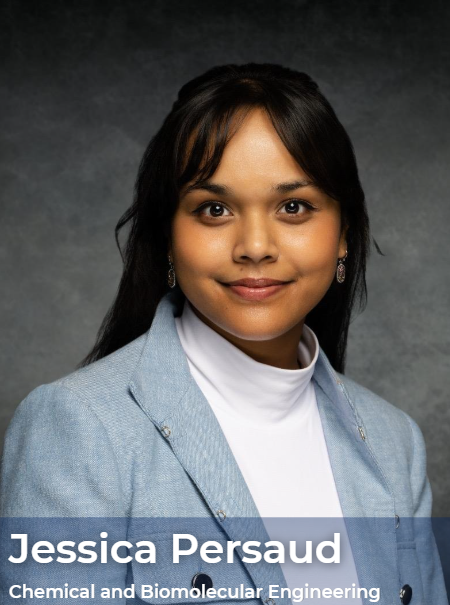
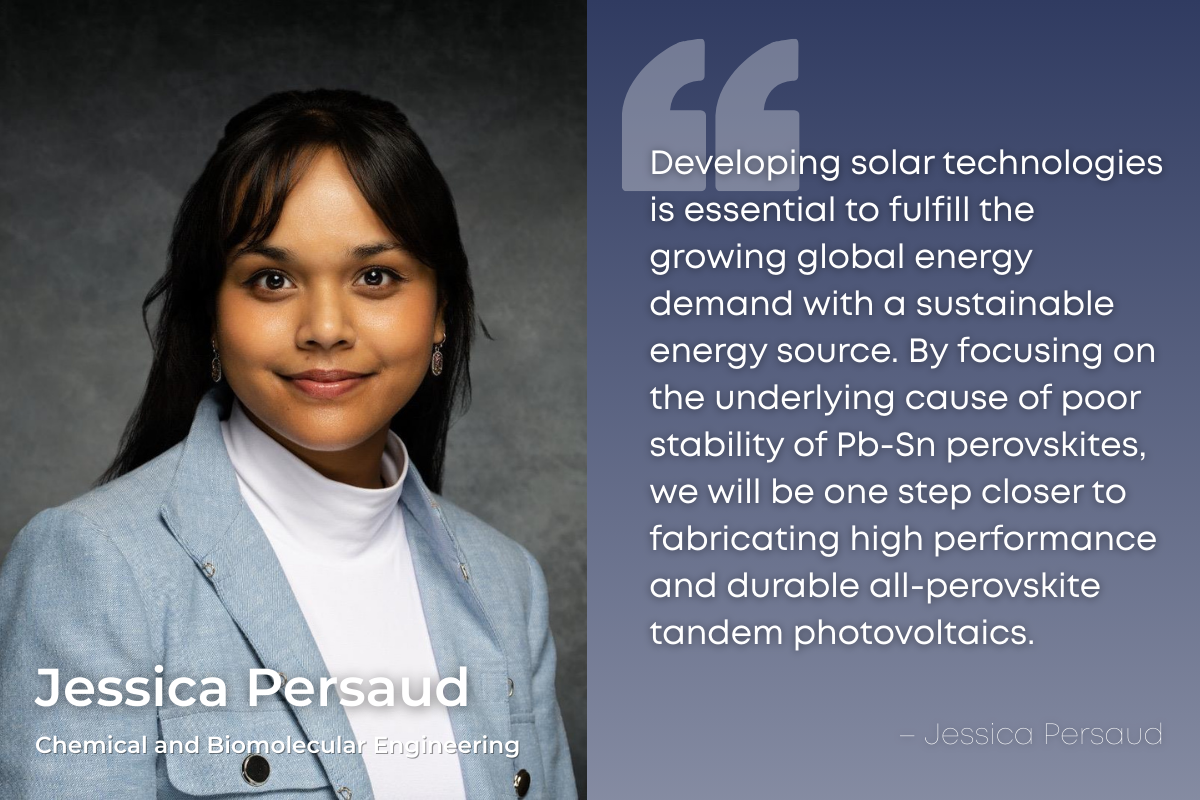
Meet Jessica Persaud
Department: Chemical and Biomolecular Engineering
Expected Graduation Date and Degree: 2026, PhD
Hometown: Huntington, New York
LinkedIn: Jessica Persaud
Google Scholar: Jessica Persaud
Q: What broad problem does your thesis aim to address?
A: My thesis focuses on understanding and improving all-perovskite tandem solar technologies to mitigate future energy scarcity and facilitate the implementation of renewable energies.
Q: Can you provide more scholarly depth to your research?
A: All-perovskite tandems are attractive due to their all-solution processability for facile fabrication and maximum theoretical efficiencies surpassing 40%. Lead-tin (Pb-Sn) perovskites are promising materials for the narrow bandgap material as they have bandgaps as low as 1.25 eV. My work aims to understand the crystallization mechanism behind Pb-Sn perovskites by solely studying and improving the crystallization dynamics of Sn perovskites, since the presence of Sn is the limiting factor towards higher efficiencies and stabilities. In isolating Sn perovskite formation dynamics, we can leverage our understanding to fabricate highly efficient and durable Pb-Sn perovskites for all-perovskite tandems.
Q: Are there any products from your work so far that you'd like to highlight?
A: Below are selected presentations I have given based on my thesis:
1.“Tailoring Crystallization of Tin-based Perovskites for Photovoltaic Applications,” Materials for Sustainable Development Conference, Sevilla, Spain, March 2025, oral
2.“Tailoring Crystallization of Tin-based Perovskites for Photovoltaic Applications,” Materials Research Symposium, Boston MA, December 2024, oral
3.“Understanding Crystallization Dynamics of Tin-based Perovskites,” Smalley-Curl Institute summer research colloquium, August 2024, poster
Q: In your view, what is the most pressing sustainability challenge today?
A: From my perspective, the cost of integrating and sustaining renewable energies into the existing energy infrastructure is the immediate challenge impeding renewable technologies. The high initial startup costs and the energy lost due to the intermittency of wind and solar solutions hinder companies from implementing these technologies.
Q: How do you see your research contributing to solutions for sustainability challenges?
A: With my research focusing on all-perovskite tandem solar technologies, if this proves to be successful, these systems can be easily integrated with data centers as a sustainable source for their increasing energy demands or with other energy storage technologies, such as photochemical water splitting for green hydrogen.
Q: What are your career aspirations after graduation?
A: After graduation, I hope to continue working on photovoltaic technologies in industry.
Q: Would you like to acknowledge any funding sources or advisors who have been especially supportive of your research journey?
A: I would like to acknowledge Professor Aditya Mohite for supporting and providing a space for my creative and scientific growth, my undergraduate research advisor Professor Stephanie Lee for encouraging me to continue research despite my fears, and the NSF GRFP for funding three years of my Ph.D.