
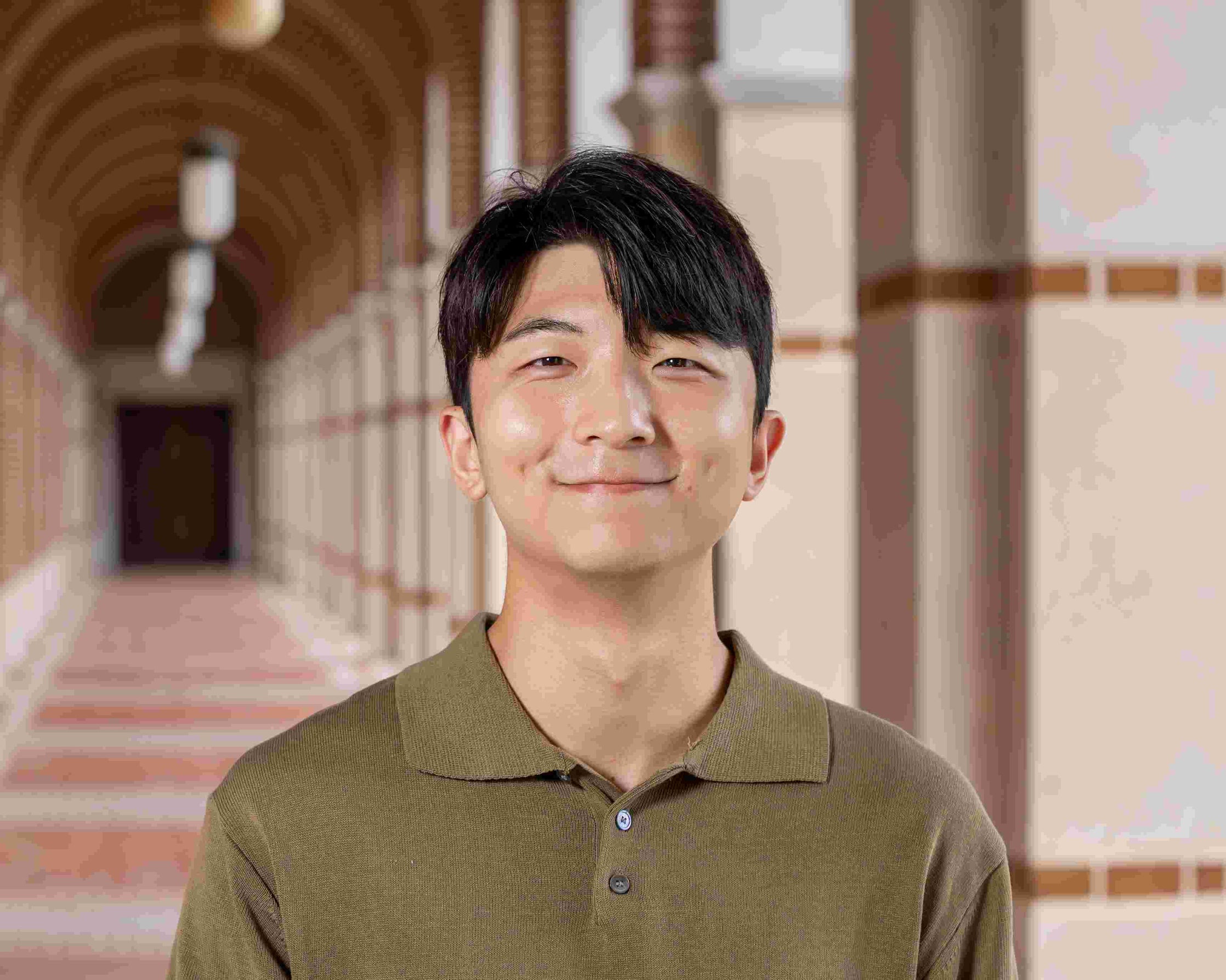
Meet Jaewoo Kim
Department: Earth, Environmental and Planetary Sciences
Expected Graduation Date and Degree: 2027, Ph.D.
Hometown: Seoul, South Korea
LinkedIn: Jaewoo Kim
Q: What broad problem does your thesis aim to address?
A: My thesis aims to address the challenge of ensuring safe and sustainable operation of Enhanced Geothermal Systems (EGS) by developing fiber-optic-based methods to monitor and image subsurface fracture networks in real time.
Q: Can you provide more scholarly depth to your research?
A: Enhanced Geothermal Systems (EGS) can provide carbon-neutral baseload energy, but their success hinges on reliable monitoring of subsurface stress to control fluid injection and avoid induced seismicity. Microseismic focal mechanisms are a key diagnostic, yet conventional seismic arrays are costly, sparse, and poorly suited for high-temperature geothermal conditions. My research develops a Distributed Acoustic Sensing (DAS)-based workflow that converts fiber-optic cables into dense seismic arrays for real-time microseismic monitoring, focal-mechanism estimation, and stress inversion. I combine graph neural networks for event detection and localization, multi-channel cross-correlation for polarity picking, and forward modeling of synthetic DAS responses to overcome the limitations of axial-strain measurements. The outcome is a scalable, automated monitoring system that delivers continuous, high-resolution stress information across entire reservoirs. This enables dynamic injection management, improved reservoir permeability, and reduced seismic risk — advancing the safe and sustainable deployment of geothermal energy.
Q: Are there any products from your work so far that you'd like to highlight?
A: Conference presentation: 2025 International Meeting for Applied Geoscience & Energy Invited talk: 2025 Korea Meteorological Administration
Q: In your view, what is the most pressing sustainability challenge today?
A: In my view, the most pressing sustainability challenge today is meeting the rapidly growing global electricity demand — driven in large part by the rise of AI data centers — while ensuring that this demand is met through efficient and sustainable energy sources. The pace of energy transition must accelerate to balance technological progress with climate responsibility.
Q: How do you see your research contributing to solutions for sustainability challenges?
A: My research contributes to sustainability by advancing geothermal energy, a carbon-neutral baseload resource, through safer and more efficient monitoring methods. By developing fiber-optic-based workflows for real-time stress monitoring and seismic risk reduction, my work helps make geothermal projects more reliable, cost-effective, and publicly acceptable — key factors for scaling sustainable energy.
Q: What are your career aspirations after graduation?
A: After graduation, I aspire to contribute to large-scale energy projects such as commercial Enhanced Geothermal Systems (EGS) or Carbon Capture and Storage (CCS). My goal is to implement practical, DAS-based monitoring systems that enhance safety, efficiency, and sustainability in subsurface operations. In the longer term, I hope to help bridge academic innovation and industrial deployment, advancing the global transition to clean energy.
Q: Would you like to acknowledge any funding sources or advisors who have been especially supportive of your research journey?
A: I gratefully acknowledge the support of the U.S. Department of Energy’s Geothermal Technologies Office through the Utah FORGE project (DE-EE0007080). I also thank the FOGMORE team for their collaboration and insightful discussions, and above all, my advisor Professor Jonathan Ajo-Franklin for his invaluable mentorship and guidance throughout my research journey.