
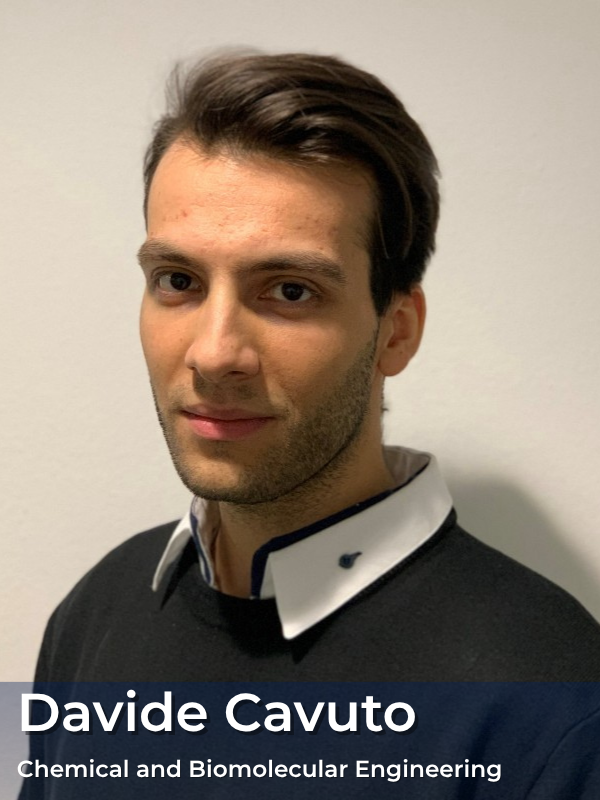
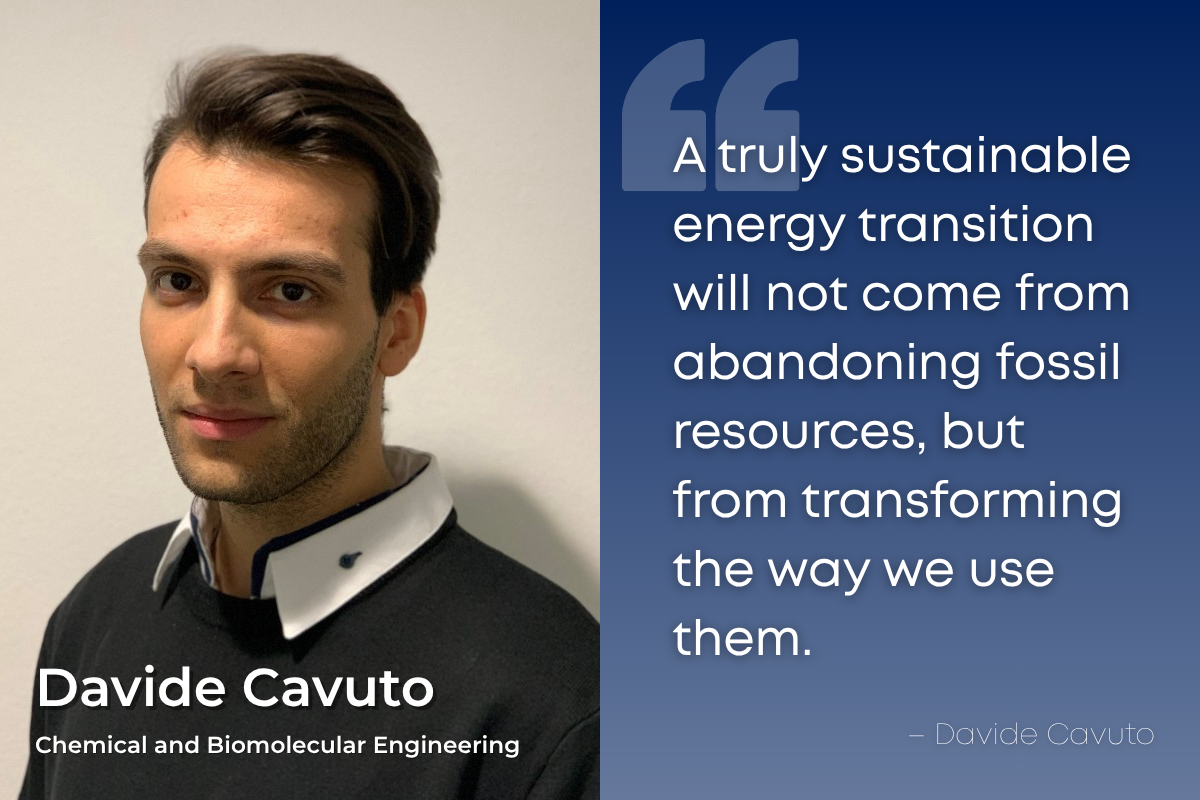
Meet Davide Cavuto
Department: Chemical and Biomolecular Engineering
Expected Graduation Date and Degree: 2028, Ph.D.
Hometown: Tollo, Italy
LinkedIn: Davide Cavuto
Google Scholar: Davide Cavuto
Q: What broad problem does your thesis aim to address?
A: Broadly speaking, my thesis aims to address the energy and materials transitions by intensifying processes for the co-production of carbon nanotubes and hydrogen.
Q: Can you provide more scholarly depth to your research?
A: Current Floating Catalyst Chemical Vapor Deposition (FC-CVD) reactors can produce high quality carbon nanotubes, along with hydrogen (turquoise), in a continuous process that has potential for industrial scale up. Before scaling up the synthesis, the process has to be intensified at lab-scale. My research focuses on intensifying this catalytic process by: 1) reducing process dilution 2) increasing carbon precursor conversion 3) increasing the catalyst activity. The first problem is addressed by developing a novel catalyst delivery method that cuts by three orders of magnitude the amount of carrier gas required for catalyst injection. The second challenge, natural gas (or methane) limited conversion, is addressed by implementing a gas recycling loop that allows for a threefold increase in feedstock conversion. The third and final challenge is overcome by designing a reactor configuration that increases catalyst activity by physically separating catalyst formation from feedstock activation. Broadly, my research requires the daily and often simultaneous application of theoretical and practical expertise in chemical reaction engineering, mass and energy transfer, catalysis, materials science, and fluid mechanics.
Q: Are there any products from your work so far that you'd like to highlight?
A: So far I have been co-authored in three peer-reviewed articles (please find them here: Davide Cavuto. So far, I have co-authored three peer-reviewed articles. We recently published an article covering one of the goals proposed for the intensification of FCCVD reactors. My first personal article should be coming out by the end of the year.
Q: In your view, what is the most pressing sustainability challenge today?
A: A sustainable energy transition can occur only by exploitation of non-renewable natural resources. As such, the most pressing sustainability challenge is understanding how to use these resources while fostering economic and social development, and in compliance with environmental needs.
Q: How do you see your research contributing to solutions for sustainability challenges?
A: My research supports sustainable fossil fuels exploitation for materials and energy production. Catalytic pyrolysis of hydrocarbons represents a promising technology that energy companies should consider integrating into their portfolios to advance the energy transition while maintaining a competitive and profit-oriented business model.
Q: What are your career aspirations after graduation?
A: I want to be an expert in sustainable technologies. Pursuing this aspiration will probably take me away from Academia. I see myself working in the energy industry, first as a researcher, because this is what I have been trained for. Later, I would like to be involved in the technology strategy development of the company.
Q: Would you like to acknowledge any funding sources or advisors who have been especially supportive of your research journey?
A: Of course, I would like to acknowledge my advisor, Matteo Pasquali and my funding sources, The Novo Nordisk Foundation and the Kavli Foundation.