
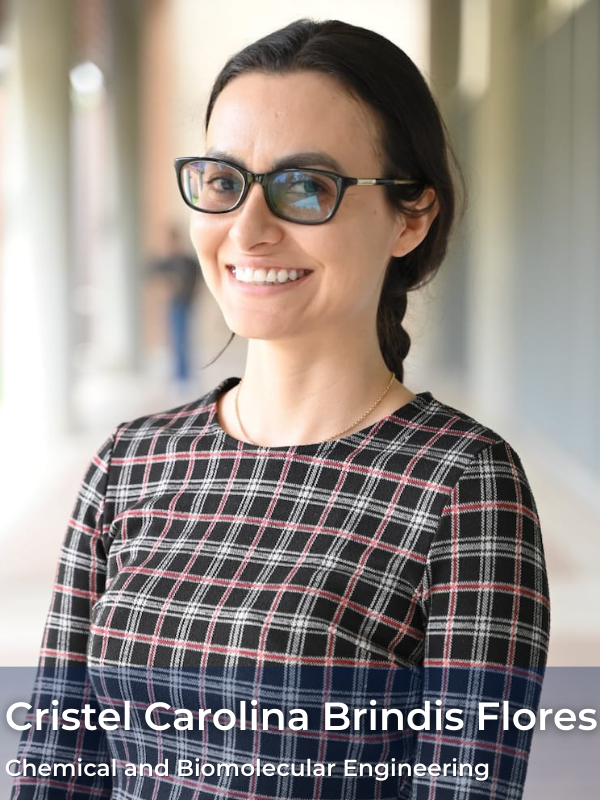
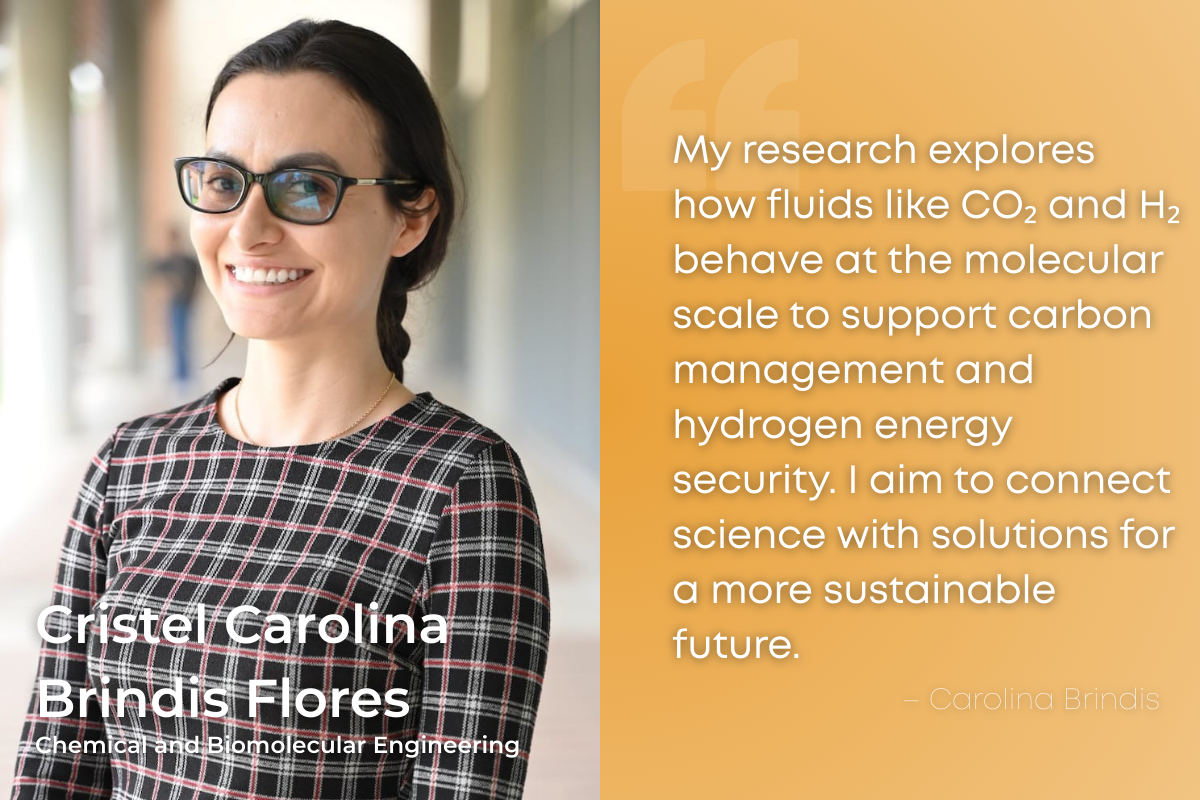
Meet Cristel Carolina
Department: Chemical and Biomolecular Engineering
Expected Graduation Date and Degree: 2027, Ph.D.
Hometown: Mexico
LinkedIn: Carolina Brindis
Google Scholar: Carolina Brindis
Q: What broad problem does your thesis aim to address?
A: My thesis addresses the challenge of predicting and understanding how fluids behave in polymers and geological media through their transport, storage capacity, partitioning, and recovery to provide molecular-level insights that guide technologies for hydrogen and carbon storage, carbon capture, and enhanced gas recovery in shale and other subsurface energy applications.
Q: Can you provide more scholarly depth to your research?
A: My research combines molecular dynamics simulations, statistical mechanics, and molecular density functional theory (mDFT) to study fluid transport, NMR relaxation, and partitioning in condensed phases. I focus on molecules such as CO₂, H₂, and N₂ in polymers and subsurface media like kerogen, where dynamics are slow, heterogeneous, and often deviate from classical models. This framework provides multiscale insights into fluid behavior in disordered and glassy phases, offering molecular-level understanding that informs the evaluation of membranes, porous materials, carbon capture and storage strategies, and enhanced gas recovery in shale systems, all of which are critical to the energy transition.
Q: Are there any products from your work so far that you'd like to highlight?
A: So far, my work has led to several scholarly outputs, including oral and poster presentations at conferences such as AIChE and Energy HPC, as well as at local symposiums and departmental meetings. I recently presented “Permeability through polymeric membranes: Insights from Molecular Simulation and Statistical Mechanics” at the AIChE Annual Meeting, and “Subsurface Storage of Hydrogen and CO₂ while Enhancing Gas Production” at Rice University. I am also preparing a manuscript on NMR spin–rotation relaxation and diffusivity of CO2 in condensed phases, which will be submitted soon.
Q: In your view, what is the most pressing sustainability challenge today?
A: The most pressing sustainability challenge today is achieving the global transition to low-carbon energy systems while meeting growing energy demands. This transition requires not only reducing CO₂ emissions but also developing scalable solutions such as carbon and hydrogen storage, carbon capture, and advanced materials to enable these technologies.
Q: How do you see your research contributing to solutions for sustainability challenges?
A: My research contributes by providing molecular-level insights into how fluids such as CO₂ and H₂ interact with complex materials like polymers and subsurface media. By developing predictive models of transport and NMR relaxation, my work helps bridge the gap between fundamental science and the evaluation of storage strategies. These advances can inform the development of technologies for hydrogen and carbon storage, carbon capture and subsurface energy applications — critical steps toward a more sustainable energy future.
Q: Do you have any forthcoming publications, presentations, or creative scholarly products to highlight?
A: Yes. I am preparing a manuscript on NMR spin–rotation relaxation and diffusivity of CO₂ in condensed phases, which I expect to submit soon. In November, I will also present my research on “Nuclear Magnetic Relaxation and Diffusion in Carbon and Hydrogen Geostorage: Insights from Molecular Simulations” at the AIChE Annual Meeting in Boston, where I have two poster presentations and one oral talk scheduled.
Q: What are your career aspirations after graduation?
A: After graduation, I aspire to pursue a career in research and development within the energy and chemical industry, applying molecular simulation and materials modeling to sustainable technologies such as carbon and hydrogen storage, and advanced membranes. In the long term, I aim to bridge fundamental science with industrial applications to accelerate the energy transition and deliver scalable solutions to global sustainability challenges.
Q: Would you like to acknowledge any funding sources or advisors who have been especially supportive of your research journey?
A: I would like to acknowledge the support of my advisor, Professor Walter Chapman and Professor Philip Singer, for their guidance throughout my research journey. I am also grateful for the funding provided by Shell during my second year and by the Chevron Energy Graduate Fellowship, as well as the institutional resources at Rice University that have supported my work.